

There is a useful test for any executive conference: six months after it ends, are the conversations still happening? Not the social media citations or the conference photographs — the actual conversations. The ones that surface in leadership team meetings, in talent reviews, in the hard discussions about what kind of organization you are building.
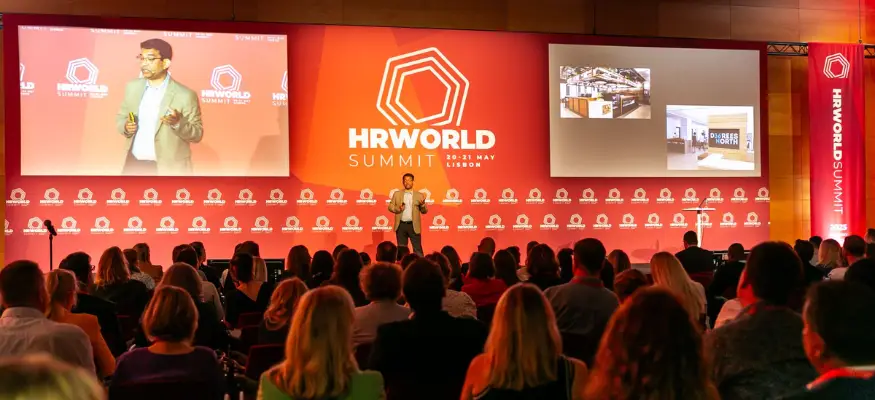
By that measure, HR World Summit 2025 in Lisbon delivered more than most. Across two days of keynotes, track sessions, and peer dialogue, a coherent argument emerged — not a collection of trend reports, but a sustained case that HR leadership has entered a genuinely different period. One defined not by the tools available, but by the clarity of purpose required to use them well.
Five sessions from that programme stand out. Not because they were the most technically sophisticated, but because they addressed questions that have not become easier since May last year. What follows is a reflection on each — and why they matter as much now as they did then.
The Future of HR Is Not Coming — It Has Already Arrived
Graeme Codrington opened the summit with a provocation that set the tone for everything that followed. The problem identified was not a lack of awareness among HR leaders — most in the room were fully conscious of AI, flexible work, generational change, and the gig economy. The problem was action. Specifically, the gap between knowing the landscape has changed and actually redesigning HR systems to reflect it.
He identified five forces shaping the near-term workforce: AI, work-from-anywhere, fluid career paths, human-machine collaboration, and the multi-generational workforce. None of these are new topics. What Codrington argued, with notable precision, is that organisations still treating these as future considerations are already behind. The default posture in most HR functions remains reactive — responding to change rather than architecting it.
The implication for senior HR leaders is direct: a comprehensive audit of existing HR strategy is not a planning exercise but an immediate operational necessity. Codrington’s session resisted the temptation to offer a framework in its place. The argument was structural — that HR’s credibility as a strategic function depends on demonstrating foresight, not just responsiveness.
Agentic AI and the Ownership Question No One Has Answered
Prithwiraj Choudhury’s keynote was, in retrospect, the one most likely to generate sustained debate. His thesis — that agentic AI will fundamentally reshape work-from-anywhere by creating ‘codified selves,’ AI agents that mirror an individual’s working patterns and can operate autonomously — attracted significant attention in the room.
The concept is not science fiction. These AI agents, trained on an individual’s communications, decisions, and workflows, can handle asynchronous tasks, preserve institutional knowledge, and operate when the human is offline. The productivity implications are significant. But Choudhury’s most important contribution was the question he raised rather than the solution he offered: who owns these agents?
If an organisation trains an AI model on three years of a senior leader’s decision-making, and that leader leaves, who retains the asset? The intellectual property implications are unresolved. The contract implications are unresolved. Most HR functions are entirely unprepared for this conversation — yet it is already a live concern in organisations piloting these technologies. The legal and HR teams that engage now will be substantially better positioned than those who engage in response to a dispute.
Mother Leadership: The Model Most Organisations Are Not Ready to Discuss
Prof. (Dr.) Rama Prosad Banerjee‘s session was the one most likely to generate scepticism on first hearing and reconsideration on reflection. ‘Mother Leadership’ — a model grounded in nurture, long-term developmental thinking, and care as a leadership discipline — is not the vocabulary most boardrooms use. That is, in part, the point.
Banerjee’s argument is not a soft one. It is grounded in evidence. In organisations where leadership has been redesigned around developmental care — where leaders are explicitly accountable for the long-term growth of their people, not just their quarterly output — measurable outcomes follow. Absenteeism drops. Team cohesion improves. Discretionary effort increases.
The ‘mother’s mind’ framework he proposed is not gender-specific. It is a set of dispositions: a long view, an unconditional investment in the individual, and a refusal to treat the person as instrumental to a target. In an era where HR is being asked to demonstrate its impact through data, this session made the case that the most durable data points — retention, engagement, collaboration — are downstream of leadership quality, not upstream of it.
For CHROs asking how to redesign leadership development programmes, Banerjee’s session offered a coherent starting point: not competency frameworks and assessment centres, but a fundamental question about what leaders believe their responsibility to their people actually is.
Humanocracy: What Transformation Actually Requires
Michele Zanini’s keynote was the sharpest structural critique of the two days. Drawing on the Humanocracy research, he argued that most organisational transformation efforts fail not because of poor execution but because of an architectural error: they attempt to make bureaucratic systems more agile without dismantling the bureaucratic logic that makes them slow.
The distinction matters. When HR functions launch culture change programmes within existing hierarchical structures, they are typically rearranging rather than redesigning. The system’s incentives, decision rights, and accountability structures remain intact — and those structures will consistently outcompete the culture programme. Zanini’s argument is that genuine transformation requires devolving authority to where the work actually happens, creating accountability at the individual level rather than the role level, and accepting that a humanocracy — an organisation built around human potential rather than hierarchical position — looks structurally different from what most large organisations currently are.
This is not an easy conversation to take back to an executive committee. Zanini was direct about that. But for HR leaders who have spent years watching well-designed programmes fail to shift deeply embedded behaviours, his diagnosis carries weight. The question it leaves is not ‘how do we change our culture’ but ‘what in our structure is preventing the culture we say we want?’
Emerging Technology and the Workforce Preparation Gap
Josh Drean closed the summit with a session that was deliberately provocative. His ‘future shock’ framing — borrowed from Alvin Toffler, updated for an era of generative AI, quantum computing, and immersive environments — was a direct challenge to the pace at which organisations are preparing their people for technological change.
The argument is not that technology will replace the workforce. Drean was consistent on this point: the technologies he described augment human capability; they do not substitute for it. The risk is not displacement but unpreparedness. Organisations that fail to invest in workforce technology literacy — particularly among demographics less likely to self-educate on emerging tools — will face an internal capability gap that no hiring strategy can close quickly enough.
His discussion of the metaverse as a learning and collaboration environment was, for some in the room, a step beyond current operational reality. But the underlying point was sound: the organisations that will benefit most from emerging technology are those that have built a culture of deliberate experimentation rather than reactive adoption. HR’s role is to create the conditions for that experimentation — and to ensure that access to it is equitable across the workforce, not concentrated in the functions already most comfortable with technology.
The Thread Running Through All Five Sessions
What connects these five sessions is not a theme so much as a diagnostic. Each speaker, from a different angle, identified the same structural problem: HR has the information it needs to lead differently, but the organisational conditions — the structures, incentives, and leadership models — have not yet changed to match the available insight.
Codrington’s audit imperative, Choudhury’s ownership question, Banerjee’s developmental leadership model, Zanini’s structural critique, and Drean’s preparation gap are not separate problems. They are different faces of the same challenge: that HR functions are being asked to lead a transformation they have not yet fully undergone themselves.
That is the productive tension that defined Lisbon. And it is the tension that the most effective CHROs and people leaders are now working through — not in conference sessions, but in the daily decisions about how to allocate attention, build capability, and hold the line on what matters when short-term pressures push in a different direction.
HR World Summit 2026: Porto, May 26–27
The conversation continues in Porto. HR World Summit 2026 brings together a deliberately curated community — 75% of attendees are CHROs or direct reports — for two days of peer-level dialogue on the issues that define the next phase of HR leadership. The programme is built around the questions that senior HR leaders are actually navigating.
If the sessions from Lisbon raised questions your organisation has not yet resolved, Porto is the right room to be in.
Download the 2026 Summit Brochure to review the programme, speaker line-up, and participation criteria.